A tiny EPFL chip reads how brain regions talk, a step toward smarter depression implants
- EPFL's LogSync chip, about 4 x 2 mm, reads how brain regions work together and can signal when to send a pulse of stimulation.
- It spotted cognitive and emotional states in recorded human brain signals, and timed stimulation in rats, on under 200 microwatts.
- It is aimed at depression, PTSD and OCD, but no person has an implant yet. EPFL gives no date for patient use.
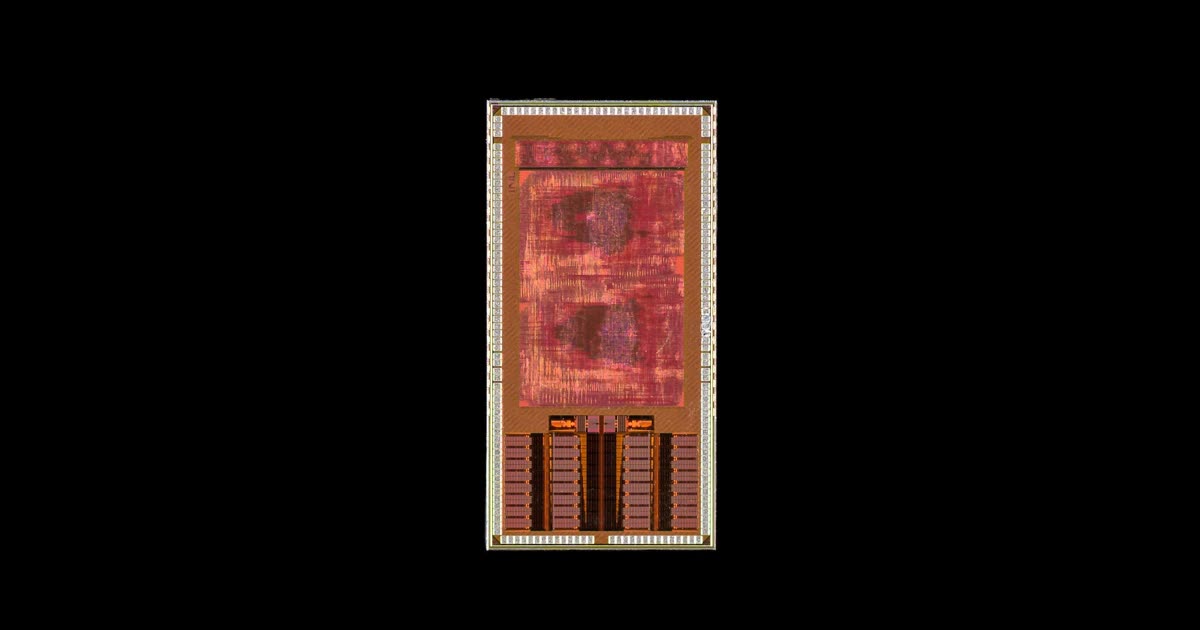
For many people with severe depression, the treatments run out before the illness does. Pills, talk therapy, sometimes more pills. A small group goes on to try deep brain stimulation, an implant that sends gentle electrical pulses into the brain. Now engineers at EPFL in Switzerland have built a chip that could one day make a brain implant for depression smarter about when to act.
The chip is called LogSync. It is about 4 by 2 millimetres, and it does something most current implants don’t: it listens to how several brain regions talk to each other, not just to one spot. That matters because, as the team argues, conditions like depression may be less about one broken area and more about a breakdown in communication. This is early research, published in the IEEE Journal of Solid-State Circuits. No patient has one yet.
How LogSync reads a conversation, not a single voice
Deep brain stimulation (DBS) is already common for Parkinson’s disease and other movement disorders. Researchers are also studying it for major depression, post-traumatic stress disorder (PTSD) and obsessive-compulsive disorder (OCD).
According to EPFL, most DBS systems run “open loop”: the pulses follow fixed settings, whatever the brain is doing. Even many adaptive, or closed-loop, systems read signals from a single region.
LogSync records brain activity and pulls out two kinds of clues. One is the strength of brain waves. The other is synchrony, how closely signals from different regions move together. A machine-learning program then uses these clues to tell cognitive and emotional states apart, and sends a trigger for stimulation when it spots a chosen state. This is the idea behind closed loop deep brain stimulation: the device responds to the brain in real time.
“Our work is based on the growing body of research suggesting that psychiatric disorders arise more from disruptions in communication between brain regions than from dysfunction of any single region,” said Mahsa Shoaran, who heads EPFL’s Integrated Neurotechnologies Lab.
What the tests showed, and what they didn’t
The team tested the chip in two ways. First, on brain recordings from earlier human studies: one set tracked how engaged people were during a mental task, another tracked emotional arousal while they watched video clips. The algorithm told these states apart from the brain signals alone. Second, in rats at the University of Minnesota, the implant followed ongoing brain waves and timed stimulation triggers to set moments in the rhythm.
It did all this on less than 200 microwatts, a tiny amount of power. Shoaran calls that a major challenge, and credits designing the hardware and the software together. She says it is a fraction of the power many implantable neural-interface systems need. The chip also uses logarithmic maths, a shortcut that makes heavy calculations simpler.
What the press materials don’t give is just as important. There are no accuracy figures, no human implant, and no date for patient use. The human tests used recorded data, not a live person. EPFL says the work is part of a CHF 6.6 million grant from the US National Institute of Mental Health.
Where a brain implant for depression stands today, if you need help now
This chip will not change treatment options this year. For now, a brain chip for depression is a lab result. In practice, implants like this usually need years of safety work, animal studies and then small human trials before any approval. That last point is our reading of how such devices usually move, not a timeline from EPFL.
What it does offer is a direction. If brain implants for mental health can respond to real patterns, rather than running on fixed settings, they might one day need less trial and error. The same idea, EPFL says, could help adaptive DBS for movement disorders too. If you are struggling now, the right next step is still a talk with a doctor about proven treatments.
Why a small power number is the real headline
On balance, this looks like a meaningful engineering step. In our reading, power is the hard limit for anything implanted in the head: more power means bigger batteries and more heat. Fitting network-level analysis into a chip this small, on this little energy, removes one real barrier.
The careful part is the gap between “it can tell states apart in recordings” and “it helps people feel better”. Those are very different claims, and only trials can close that gap. Like the brain enzyme study on memory we covered last week, this is a promising lead, not a treatment.
The next thing to watch is whether the team, or its spin-off Infera Neuro, moves LogSync into human studies. Until then, it is a small chip carrying a big question, asked the right way.
Sources (3): every key fact checked against at least two
- EPFL: Neural chip decodes interactions between brain regions (23 October 2026)
- IEEE Journal of Solid-State Circuits: LogSync, a low-power logarithmic SoC for cross-regional synchrony extraction and adaptive psychiatric state classification (D. Alex et al., 2026)
- Keystone-SDA via blue News: Brain chip could improve treatment for mental health conditions (23 October 2026)
Related stories

Wind turbines have killed about 18.7 million US bats since 1981, USGS-led study estimates
Wind turbines killing bats: a USGS-led study estimates 18.7 million US bat deaths since 1981, and shows how design, siting and slower blades can cut them.

Iceberg A-81, a slab of Antarctic ice the size of a city, slows at the edge of South Georgia
A city-sized iceberg, A-81, has slowed off South Georgia after a 2,300 km drift. What satellites show, why sizes differ, and what is still unknown.

OpenAI says its AI disproved the Exponential Time Hypothesis, and two of the rule's authors will check it
Exponential Time Hypothesis: OpenAI says its AI proved the famous computing rule false. Experts, two of them its authors, are checking. What it means.