NASA changes how astronauts will reach the Moon, ahead of a 2028 landing
- NASA has dropped its old meeting orbit around the Moon. Orion will now dock with SpaceX's Starship in Earth orbit, and Starship will push both to the Moon.
- Blue Origin's Blue Moon Mark 2 will skip refuelling, using three transfer stages to meet Orion in a polar orbit around the Moon.
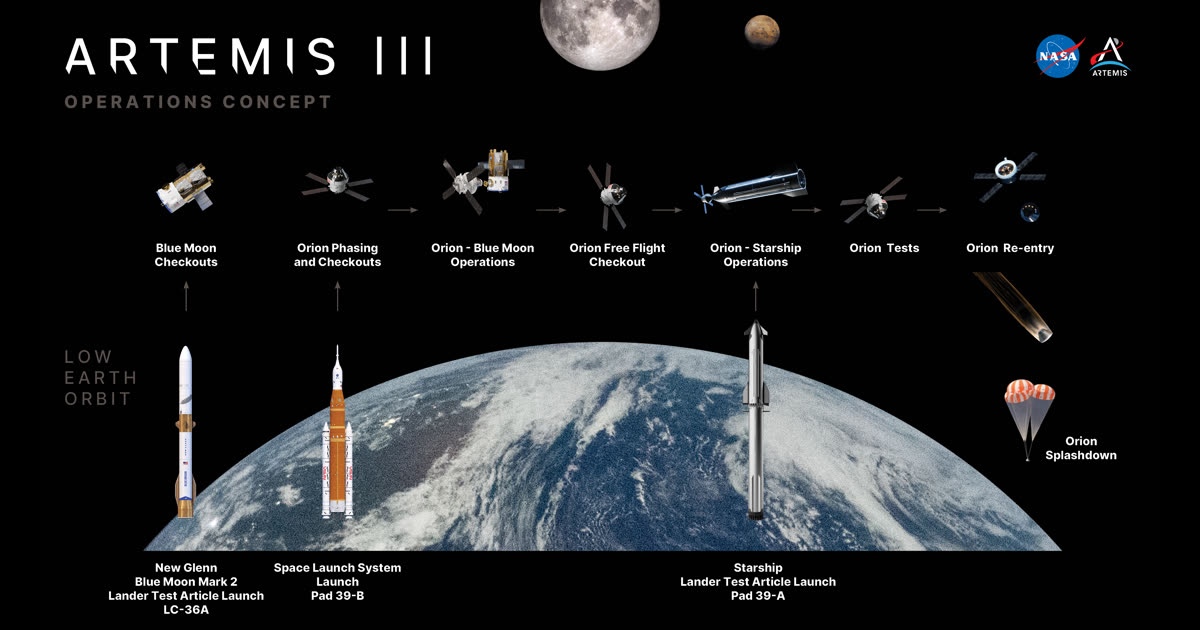
- Artemis III in 2027 becomes a 14-day test in Earth orbit with both landers. The first landing is planned for 2028, with the lander picked by readiness.
No one has walked on the Moon since 1972. The road back now starts much closer to home. On 23 October, NASA changed how its crews will reach the Moon, and kept its NASA moon landing 2028 target in place.
The biggest change is where the spacecraft meet. NASA has dropped the distant, looping orbit around the Moon where its Orion capsule was meant to pick up a lander. Instead, each lander company gets a route that suits its own vehicle. In our reading, NASA is trying to make the hard parts easier.
Two landers, two different roads to the Moon
The basics stay the same. Astronauts launch in Orion on NASA’s SLS rocket from Florida. A commercial lander links up with Orion, takes two crew members to the surface, and brings them back while two stay aboard.
For SpaceX, the Starship lunar lander will still be filled with fuel in low Earth orbit by a series of “tanker” Starships. Then it waits for Orion in Earth orbit. The two dock, and Starship fires its engines to push both all the way to a low orbit around the Moon. NASA says this cuts the fuel Starship must gather in space and shortens the trip back up to Orion after a Moonwalk. NASA is modifying Orion so it can be pushed this way.
For Blue Origin, the Blue Moon Mark 2 lander will skip refuelling in space for the 2028 mission. Three “transfer stages” launch first, then the lander joins them. They work like a rocket with several parts, each dropping away as its fuel runs out. The stack ends up in an oval-shaped orbit over the Moon’s poles, where Orion meets it.
The old meeting point was a near-rectilinear halo orbit, a long, stretched path around the Moon. Ars Technica reports that leaving it was SpaceX’s “biggest ask”, and that NASA’s cancellation of the Lunar Gateway space station earlier this year made it possible.
Artemis III becomes a dress rehearsal in Earth orbit
The Artemis 3 mission plan is now a 14-day test close to Earth, launching in 2027 (officials said summer). NASA astronauts Randy Bresnik, Frank Rubio and Andre Douglas, with the European Space Agency’s Luca Parmitano, will fly Orion to meet test versions of both landers.
They will dock with Blue Moon first and spend about two days inside it, checking the cabin, controls and air supply. Later, Orion will dock with a Starship test vehicle for up to two hours. The crew will not go inside Starship. “We’re launching three spacecraft on three different rockets and testing how they operate together, something NASA has never attempted,” said Jeremy Parsons, NASA’s Artemis program manager.
Why the NASA moon landing 2028 target hinges on fuel
So, when will NASA land on the Moon again? The target is 2028, on Artemis IV. NASA has not said which company goes first. It will pick “based on lander readiness”, and a second landing will follow. Both companies must first fly an uncrewed demonstration, and NASA must certify the landers.
The hardest number is still missing. Starship needs many refuelling flights, and nobody has shown that at this scale yet. Ars Technica reports that a NASA safety panel put the count at “about 22” launches, while Elon Musk said six to eight. NASA declined to give a number.
If you follow space, here is what to watch
The Blue Moon lander vs Starship HLS race is now real: neither is yet assigned to a landing mission. Watch three things. First, SpaceX’s refuelling tests in orbit. Second, Blue Origin’s uncrewed demo flight. Third, whether Artemis III actually flies in 2027. SpaceX, which reported a US$4.4 billion profit last quarter, has the money; the question is the engineering.
For readers outside the US, Parmitano’s seat is a reminder that Artemis is a shared effort, with Europe flying on the test.
A plan that bends to the hardware is a healthier plan
On balance, this looks like a sensible reset. Testing docking in Earth orbit first is lower risk: if something goes wrong, home is hours away, not days. Letting each company use the orbit that suits its vehicle, and keeping both in the race, should give NASA a backup.
The caution is that the plan is only as good as the hardware. Unproven refuelling, new transfer stages and a modified Orion all have to work, and NASA has given no firm launch dates. Our reading is that 2028 is possible but tight, and that the Earth-orbit test in 2027 is the honest checkpoint.
If Artemis III goes smoothly next year, the 2028 landing becomes much easier to believe. If it slips, we will know early, and that is useful too.
Sources (4): every key fact checked against at least two
- NASA: NASA, Partners Accelerate Lander Development for 2028 Moon Missions (23 October 2026)
- NASA: NASA's Artemis III Mission to Test Future Moon Lander Operations (23 October 2026)
- Ars Technica: NASA updates lander plans for Moon landings, finally solves long-festering Orion issue (Eric Berger, 23 October 2026)
- National Space Society: NASA Sets a New Course for Artemis
Related stories

Wind turbines have killed about 18.7 million US bats since 1981, USGS-led study estimates
Wind turbines killing bats: a USGS-led study estimates 18.7 million US bat deaths since 1981, and shows how design, siting and slower blades can cut them.

Iceberg A-81, a slab of Antarctic ice the size of a city, slows at the edge of South Georgia
A city-sized iceberg, A-81, has slowed off South Georgia after a 2,300 km drift. What satellites show, why sizes differ, and what is still unknown.

OpenAI says its AI disproved the Exponential Time Hypothesis, and two of the rule's authors will check it
Exponential Time Hypothesis: OpenAI says its AI proved the famous computing rule false. Experts, two of them its authors, are checking. What it means.